
Short Historical Blurbs on Early Giles County Families
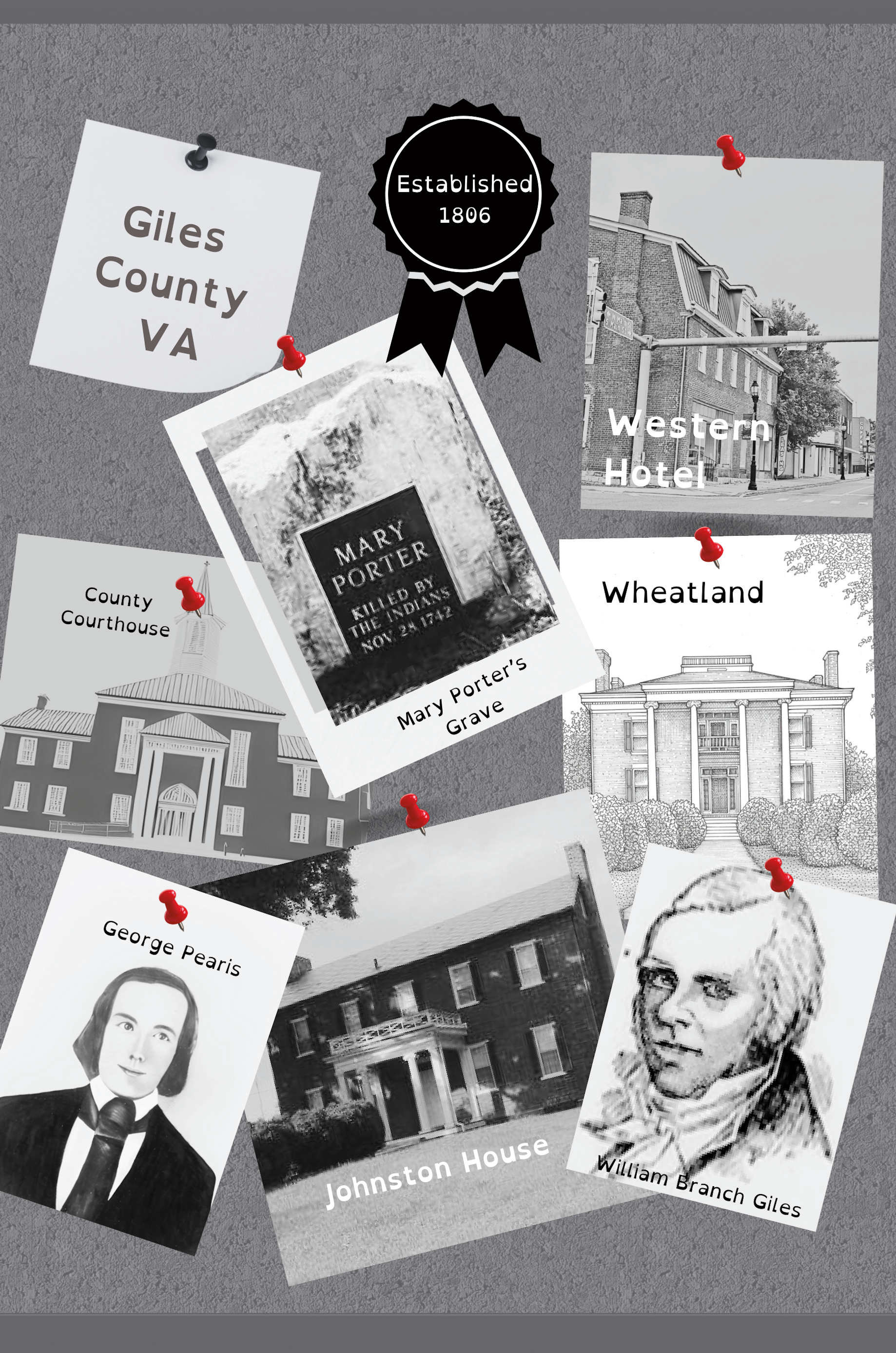
Porter Family
The earliest known settler in what later became Giles County was a woman or girl named Mary Porter who lived with her family near Glen Lyn by the early 1740s. John Toney settled in the same area around 1780, in what was then Revolutionary-era Montgomery County, where he discovered Porter's grave marker. He recorded that it bore the inscription: “Mary Porter, killed by the Indians 11/28/1742.” Mary and the rest of the Porters would have been residing dangerously and illegally in Indian territory in the year 1742, but the details of her family's story remain obscure.
Adam Harman and the 1744 Treaty of Lancaster
At a great gathering of leaders from Virginia, Pennsylvania, New York, and the Six Nations Iroquois held at Lancaster, Pennsylvania in late June of 1744, Virginia representatives Thomas Lee, William Beverley, and Col. James Patton helped negotiate a treaty in which the colonists paid the Iroquoians £400 to cede the rights to Shawnee territory in the Ohio Valley to the English, rights which the Iroquoians did not possess. Nevertheless, the colonial government accepted the treaty as better than nothing in their vain hopes to convince the Iroquoians to help fight the French in the coming French and Indian War, perhaps not appreciating that they were simultaneously creating a dangerous situation with the Shawnee to the west.
One of the agreements in the Treaty of Lancaster had been that the Iroquoians could still use their old roads and warpaths through Virginia to attack the Catawba and other rivals farther south. Now that Adam Harman’s settlement on the New River was given legal status, Lieutenant Governor Gooch used “Adam Harman’s at Tom’s Creek on New River, above the Blue-Ridge,” as a point along the frontier wagon roads which the Iroquoians would be permitted to use. James Patton had just recently petitioned the governor’s council (a forerunner of the Senate which also acted like an executive cabinet) for rights to two hundred thousand acres in order to start a new land company to settle the New River, part of the old Shawnee territory which the Iroquoians had gifted to the Virginians.
Harman himself was born some time around in the year 1700 in the German states and had probably come through Pennsylvania like many other Germans of that era. It is unclear when exactly he first took up residence in the New River Valley, but he suddenly appears after the Treaty of Lancaster near a natural ford on the New River, about one and a half miles downstream from the mouth of Tom’s Creek on what is now the Radford Army Ammunition Plant’s property. He had probably first arrived in the area earlier in the 1740s or perhaps even the 1730s, as British colonists do not appear to have been coming down the Shenandoah Valley or other routes in any appreciable numbers until around that time.
Historian Ryan Mays writes that “Harman and his family had built a cabin by June 1744, probably at the present site of the James R. Kent plantation house, on a hill overlooking the vast New River bottomland at what is now called “Whitehorne” and “Kentland Farm” in present-day Montgomery County.” Mays notes that the Kent's brick mansion built there between the 1820s and 1830s had “replaced an earlier log house built in the 1790s by Abram Trigg,” and that Trigg's structure might have been preceded on that very same site by Harman's.
Early Land Companies of the New River Valley
When Adam Harman first settled on New River around the early 1740s, it was called both “New” and “Wood's” river. The latter name derived from Colonel Abraham Wood, the commander at Fort Henry near present-day Petersburg who explored the New River as early as the 1650s. His explorers Batte and Hallam came up the Roanoke River beyond the Blue Ridge in the early 1670s, exploring a “new,” westward-flowing river. According to Ryan Mays, “the New River was called New River and Wood's River interchangeably and with about equal frequency” some seven decades later in the 1740s when Adam Harman and other frontiersmen arrived on the little-known and dangerous frontier.
It was typical for early royal officials to divide the massive western territories into more manageable chunks which they then sold or awarded as gifts, often to friends and relatives among the nobility. Enterprising colonists became more directly involved in land speculation by late colonial times, however, as attested by the proliferation of private colonial land companies buying up large tracts, dividing them into smaller plots, and later reselling them at a profit. Surviving documents show that by April 1745 Colonel James Patton had established the “New River Company” with a founding grant of one hundred thousand acres of land.
John Peter Salling (or Sally), a member of John Howard's expedition, reached the New River in March of 1742 but did not arrive back to describe his adventures until 1745. The experiences he did finally published were rather remarkable, relating for example that they slayed five buffaloes at “Mondongachate now called Woods River,” offering both an early account of buffalo in Virginia and one of the rare surviving native names for the New River or a place by it. On April 8th of 1745 John Buchanan and James Patton reported back to Orange County that they had “already Blazed and laid of[f] with Two Notches and a Cross” a clear enough swathe of wilderness “for gangs of workers to begin clearing trees and other obstacles from the path.”
John Buchanan was one of the agents of the New River Company by November 1747, when he referred to the outfit as “Col. James Patton and Company.” The company was still active in 1749 when Patton kept a “booke of Entreys & other Papers Belonging to the new River Grante on the waters of the Misisipioa on the fronteire of Virginia in North America.” Presumably the company was selling plots of land to early New River settlers over all these years following the Treaty of Lancaster.
Doctor Thomas Walker was a famous long-hunting companion of Daniel Boone and one of the most consequential frontiersmen of his era. He had his own land company, the Loyal Land Company, for which he was exploring and surveying in 1750 when he first discovered the New River on March 16th. He quickly learned the local geography and referred to the place as the “New River” in his early writings.
It was in the context of these early waves of “Indian fighting” that pioneering settlers of the New River Valley began erecting the first forts in their communities, to which residents would collectively gather and make a defensive stand in case of attack. One of the earliest such forts on the New River was located along Walkers Creek on former Farley family property, known as Farley's Fort. Another was Fort Branch in what is today Pearisburg, representing the earliest communities in what became the county’s seat.
A Few Early New River Families
A few of the earliest families on the New River frontier included the Harmans, Lybrooks, Snidows, and Chapmans. Adam Harman, a German whose name was originally spelled “Herman,” had brought his family to Eggleston by 1750. Philip Lybrook was a Pennsylvanian of Dutch descent (originally “Liebroch”) who first appeared on Sinking Creek around that same time, while Elizabeth Helm Snidow was a recently-widowed mother of eight children who pioneered Little Stoney Creek beginning around 1766. Five years later in 1771, just as another cycle of native violence was about to begin, John Chapman appeared at the mouth of Walker's Creek in a log cabin.
Attack on the Snidow, Lybrook, and McGriff Families, August 7th, 1774
[Prelude to Dunmore’s War; I can extend this or make it a series with a little more time.]
The McGriff family joined the Lybrooks near Sinking Creek along the New River by 1774, around the same time that the Irish immigrant Samuel Shannon and his family settled on Poplar Hill. On Sunday, August 7th, 1774, a colonial court in Fincastle ordered that John Burk, Andrew Hatfield, and Paulser Lybrook find the best route for a road from Tom's Creek to the foot of Rich Creek Mountain. It was on that same day, and perhaps related to the same road-surveying activities, that a native war party