
The Johnston House
Meet the Johnstons
The story begins with David Johnston, a native of Ireland, settling in the new world in Culpeper County, Virginia. In 1751 he married Nancy Anne “Nannie” Abbott, daughter of David Richard Abbott. After serving in the Revolutionary War, David Johnston arrived in Giles County in 1778 and settled on what is known as John Phlegar's farm. He served as the constable for Montgomery County. David had eight children (James, David, Andrew, Sallie, Elian, Jeminma, Virginia, and Annie). They were among the first settlers of Giles County, Virginia.
David’s oldest son, James Johnston, served in the American Revolution. David Jr. married Sallie Sallie Chapman Miller and had seven children (George, Marshall, Oscar, Chapman, Olivia, Sally, and Louisa). Andrew was a farmer and raised five children on his town lot farm with his wife Jane Henderson Johnston (James Johnston, Andrew Henderson Johnston, Docter Harvey Green Johnston, Mary Johnston, and Eliza Johnston). His son Harvey became the principal doctor of Giles County in the mid-19th century.
These two men made significant contributions to the development of the Virginia frontier and represent the Scottish migration to this area in the 1800s. Andrew's contribution was important in the context of local history, while Andrew’s son, Harvey's contribution was his service to the community. In 1806, the brothers were hired to survey and lay out the town lots of Pearisburg, which became the county seat. David and Andrew formed a business partnership where they owned farmland on the New River near their brother-in-law Isaac Chapman and with him operated a store and tanyard. They were among the original merchants of the town. The brick house in the center of town was built by Andrew and David Johnston in 1829. Andrew and his family resided in the house, while David lived outside of town. Andrew died in 1838, and his will describes the boundaries of the lot as consisting of 40 acres and half an acre upon which the house, barn, and yard were situated, as well as 10 acres of pasture land across the wagon road.
Harvey G. Johnston, Andrew's eldest son, inherited the house after the death of his mother in 1853. He was one of the most highly educated men of his time, having earned a bachelor's degree from the University of Virginia and studied medicine at the Jefferson Medical School in Philadelphia. He established a medical practice in the house to serve Giles County and built an office in the northwest corner of the town lot between 1857 and 1859. Local histories acknowledge that Brigadier General Rutherford B. Hayes made his headquarters in this office during the Civil War. The office was in constant use until Johnston died in 1881. The property was inherited by his second wife, Mary Halsey Johnston.
The Main House

The Andrew Johnston House, located in the town of Pearisburg in Giles County, boasts a beautiful five-bay façade, Flemish-bond brickwork, and molded brick cornice. Built in 1829, it is the oldest surviving house in Giles County and is a classic example of western Virginia Federal vernacular architecture. Andrew Johnston, along with his brother David, was one of the founding settlers of Giles County, and in 1806, they contracted to lay out the town lots of Pearisburg, which is now the county seat. Upon the death of his mother in 1853, Andrew Johnston's son, Harvey G. Johnston, inherited the property, and he used it as his residence and medical practice. As a prominent physician in the county, Dr. Johnston ran his practice from a small wooden building on the grounds, which was later continued by his son, Harvey G. Johnston, Jr. In 1995, the Andrew Johnston House was deeded to the Giles County Historical Society to serve as a museum that honors the Johnston family and their contributions to the county's history.
The interior design is based on a simple colonial plan with a central hall flanked by a room on either side. A dining room ell wing is attached at the rear on the ground floor. The parlor and upstairs bedrooms still have their original wide-plank yellow pine flooring, and the house possesses numerous pieces of Johnston family furniture. Rare and unusual decorative painted borders can be seen in the principal rooms on both floors.
In 1857, Dr. Harvey Green Johnston, Colonel Johnston's son, expanded the house with a wooden addition attached to the rear dining room wing. It replaced the original kitchen, which was located in the cellar. The Johnston family continued to renovate and update the house over the years. The current pressed-metal shingle roof dates from circa 1900, and the house was the first in Pearisburg to install electricity and telephones.
In 1993, the Andrew Johnston House was added to the Virginia Landmarks Register and the National Register of Historic Places.
Restored in 1998 to its nineteenth-century appearance, the Andrew Johnston House is an excellent example of a prosperous middle-class dwelling in the rural antebellum South.

Entry and Staircase
The entry hall is small but elegant. It showcases a Renaissance Revival hall tree that dates back to 1855. The tree was a gift from the wife's father to Dr. Harvey Green Johnston. Beside the stairway, there is a walnut table crafted by local cabinetmaker Harvey Niday in the 1950s. The light fixture, installed during a restoration, is from around 1900. The door beneath the stairs used to lead to a closet but was later converted to access the cellar stairs.
The stairway is a beautiful piece of architecture, with original pine treads that were later overlaid with oak in the 1920s. The stairway leads to a landing where a bathroom was added in the early 20th century. The bathroom was remodeled in the 1940s with a vanity installed in the 1970s. The restoration team removed another 20th-century bathroom on the ground floor. At the top of the stairs is an unfinished attic, currently being used for storage.
Parlor
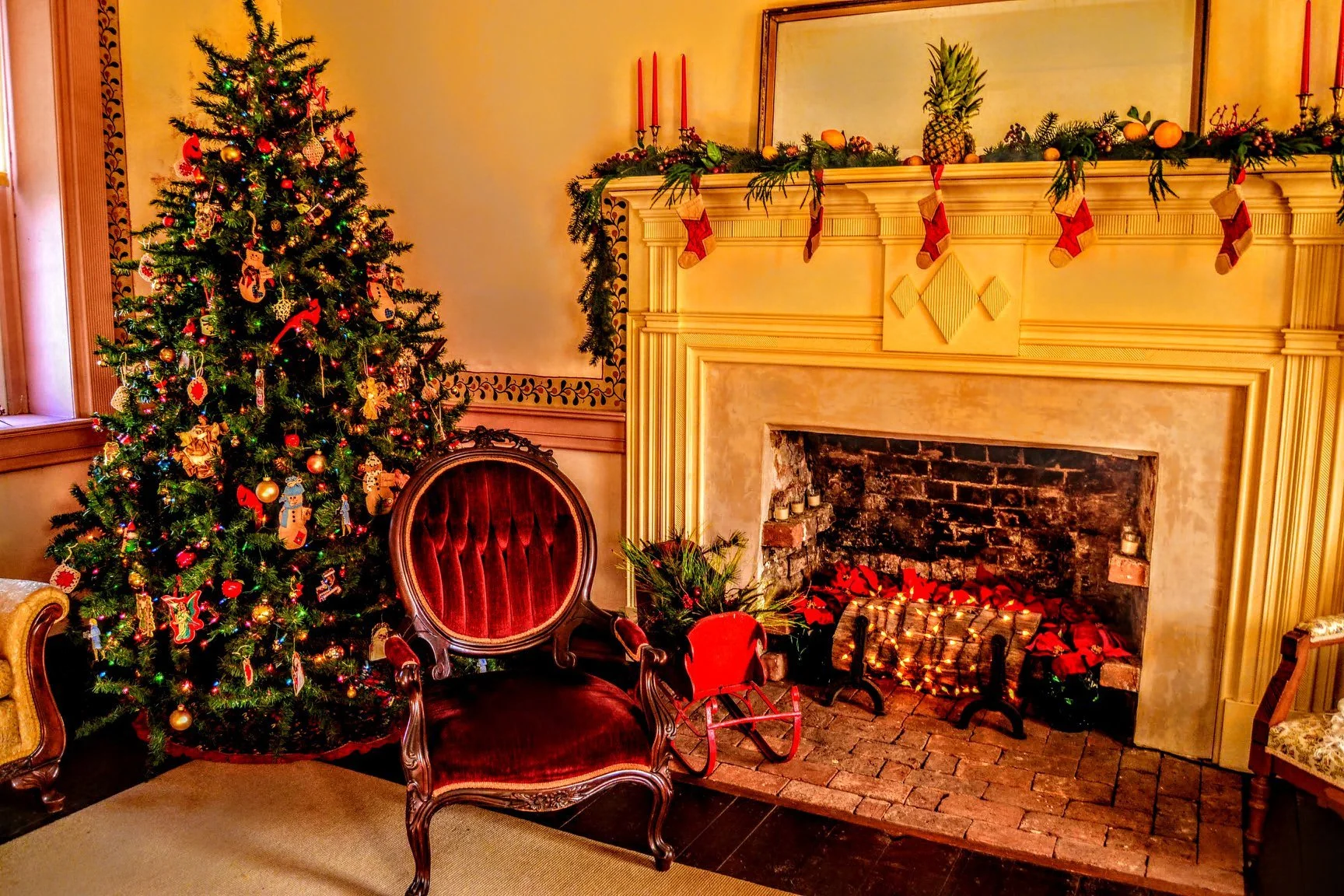
The parlor in the Johnston House is an important room for entertaining visitors. It has the most elaborate woodwork in the house and rare stenciled decoration, which is not common in 19th-century homes in Virginia. During restoration in 1998, the stenciled decoration was discovered after the wallpaper was removed. The room was painted to look like French wallpaper, with swags at the top and a vine and berry border above the chair rail. The wall under the chair rail was originally painted with a column design in orange and peach, and one section of it has been restored.
Sometime before 1930, the fireplace mantle was removed and the room was remodeled as a bedroom. During restoration, the present mantle was installed and narrow oak floorboards were removed to reveal the original pine flooring.
Except for Dr. Johnston's desk, the furnishings in the parlor are either gifts or loans from local residents. The rosewood-veneered square grand piano is from New York and was purchased from Nash & Woodhouse in Richmond before the Civil War. It was transported by wagon to Pearisburg and stood in the Western Hotel for many years. Other furnishings in the parlor include a pedestal table with matching maple armchair and glider, a walnut piecrust table, and a Victorian sofa dating to circa 1900.

Dining Room
The dining room boasts the original Federal-style mantle with a mirror on top, along with a small section of the wall that still maintains the early 19th-century hand-painted decoration. The room is furnished with several pieces of furniture that were owned by the Johnstons, including a large cherry china press from the mid-18th century, a walnut pie safe from around 1850, a sideboard from the late 1800s, and a cherry banquet table from between 1820 to 1840, which has two half-moon extensions. One of the extensions was created in the 1950s by a local cabinet maker named Harvey Niday to replace the original. The room features eight mahogany Empire-style chairs from the 20th century and a modern oriental-style carpet that matches the period. The lighting fixture was installed during the restoration period and is also of the same period.


The Kitchen
The original kitchen of the house was located in the basement, which was a common feature of Georgian architecture. However, there was no staircase connecting the basement to the first floor, so food had to be carried through an outdoor door and back inside to the dining room. The basement still shows signs of a hearth indicating where the original kitchen was located, although the entrance has now been bricked up.
An adjoining kitchen was added in 1857 and was updated in the 1940s. The enclosed porch that was previously attached to the kitchen served as a breakfast room. Additionally, a door on the east side of the porch provided access to the meat house.

Living Room
Other furniture pieces in the living room are gifts and loans from community members. In the past, the living room served multiple purposes, such as a sitting room and a bedroom. The original pine flooring was covered by narrow plank oak flooring in the 1920s, which extended to much of the ground floor. The circa 1830 Federal-style mantle was obtained from a nearby farm and installed in the Johnston house in 1940. As part of the restoration, the plastered wall was adorned with Royal Limoges wallpaper.
The furniture in the living room belonged to the Johnston family and consisted of a piano-hinge desk, rocking chair, marble-top pedestal table, and an Eastlake armchair with a rush seat, all of which date back to the 19th century. The Chippendale-style drop-front desk was made by a local cabinetmaker, Harvey Niday, for the Johnston family in the mid-20th century.
Other furniture pieces in the living room are gifts and loans from community members. They include a 19th-century sofa and a 20th-century velvet upholstered mahogany armchair. The Victorian-style carpet is modern.. These include a 19th-century sofa and a 20th-century velvet upholstered mahogany armchair. The Victorian-style carpet is modern.
Master Chamber
Above the chair rail in the room, there is a rare stenciled decoration featuring a vine and berry motif. The windows are framed by thistle leaves, symbolizing from the heart, and vines with pineapples, which symbolize "welcome." The ceiling is bordered by a quilt or Pennsylvania Dutch design. The original Federal-style mantle is still in place and there is a small door opposite the bed, which provides access to the attic of the dining room wing. The original yellow pine wide-plank flooring is still present throughout the second floor.
The bed in the room is an elaborately carved Rococo-style walnut bed, which was a wedding gift from Dr. Johnston's father-in-law, circa 1855. The coverlet was designed for this bed in 2000 by Jean Bane, who spent over 1000 hours crocheting and sewing together the pinwheel-design cotton squares. Other Johnston family pieces include a 19th-century Renaissance Revival marble-top dresser, a walnut and marble washstand, and an Eastlake walnut wardrobe. The small trunk on the hearth was used by Dr. Johnston's son at college. A walnut folding crib, circa 1875, was a gift to the museum.
Children’s Room
In the room, there is a striking 6-foot square rope bed that dominates the space. It is a family piece that dates back to the mid-19th century and was originally designed to accommodate multiple children. In 1940, the original mantle and hearth were removed and replaced with storage closets.
Marjorie Johnston, the last Mrs. Johnston to live in the house, used a screened indoor-outdoor crib for her daughter Mary Jane. Sadly, Mary Jane passed away at the age of three, and some of her clothes can still be seen in the closet.
Moreover, the room boasts a small walnut Victoria washstand and a pedestal-style dresser covered with burled walnut veneer. The dresser stands where the original hearth was located.